
Notes
(04)
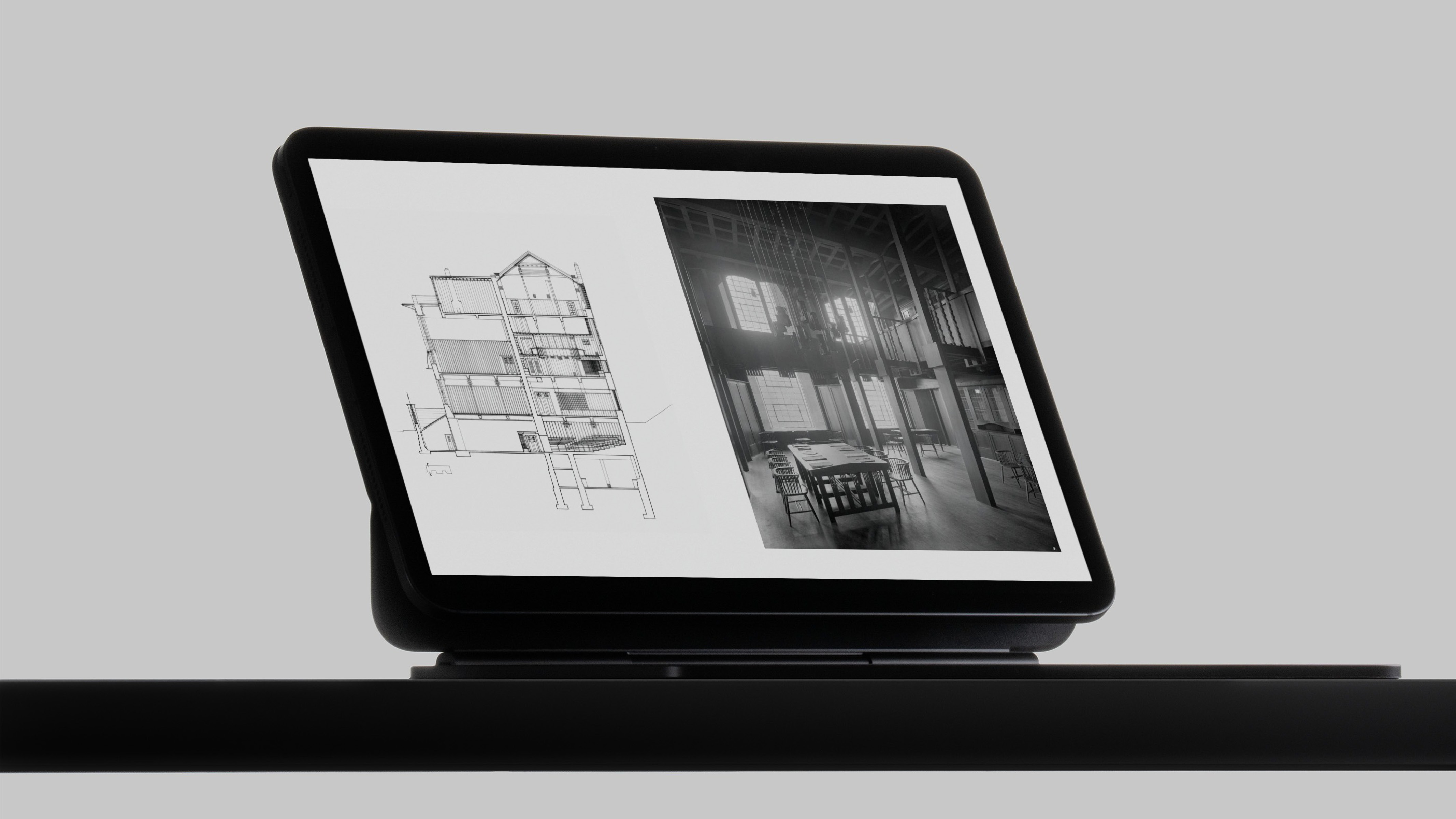
When Charles Rennie Mackintosh designed the Glasgow School of Art, he didn’t stop at the building. He designed its chairs, tables, light fittings and ironwork, and shaped all of it around the students and staff who would use it every day.
For much of the last century, this was how many of the best-known designers worked. Mies van der Rohe designed the Barcelona Pavilion and the chair that sat in it in the same year. Alvar Aalto designed the Paimio Sanatorium and the chair its patients sat in, angled to help them breathe more easily. Le Corbusier gave furniture the same seriousness as his buildings.
None of them treated a chair as a lesser commission than a building, or a light fitting as an afterthought. Each was a chance to carry the same thinking a little further, and the result is work that reads as one piece rather than a collection of separate decisions.
The Mackintosh Building is one of the clearest examples of this anywhere. Whatever your taste, it is hard to find another building where so much was considered at every scale, and with the people inside it so clearly in mind.
The library showed it best. The bookcases, tables, chairs and the clusters of pendant lights between the timber columns were all designed as part of the same room. Its loss to fire in 2014 was felt far beyond Glasgow, because there was nothing else quite like it.
Coherence here doesn’t come from a repeated style. It comes from one way of thinking applied to everything, so that the building and what fills it clearly belong together. It’s an approach we rarely see today. Most buildings are designed by one team, fitted out by another and furnished from a catalogue by a third.
A few designers still work this way. Vincent Van Duysen designs furniture as well as buildings and interiors. John Pawson has applied the same restraint to a Cistercian monastery and to a range of cookware. The scale changes. The thinking doesn’t.
Some of the most interesting design happens when a designer steps outside their own field. Charles Eames trained in architecture, and the moulded plywood chairs he and Ray Eames designed grew out of leg splints they made during the Second World War. Mies’s chair and Aalto’s are memorable partly because they were designed by people thinking like architects.
Expertise in one discipline can harden into habit. Moving into another removes the habits and keeps the thinking, and that is often where the most distinctive work begins.
As children, our creativity isn’t divided into disciplines. We draw, build, paint and make things without asking which one we’re supposed to be doing. Somewhere along the way, that gets separated into careers.
We don’t believe it has to be. The same care that shapes a building can shape a room, a website or the way a business presents itself, and when it does, the result is more coherent and more personal. That is what makes the Glasgow School of Art work, and it’s why marcus.house works across disciplines today.

